


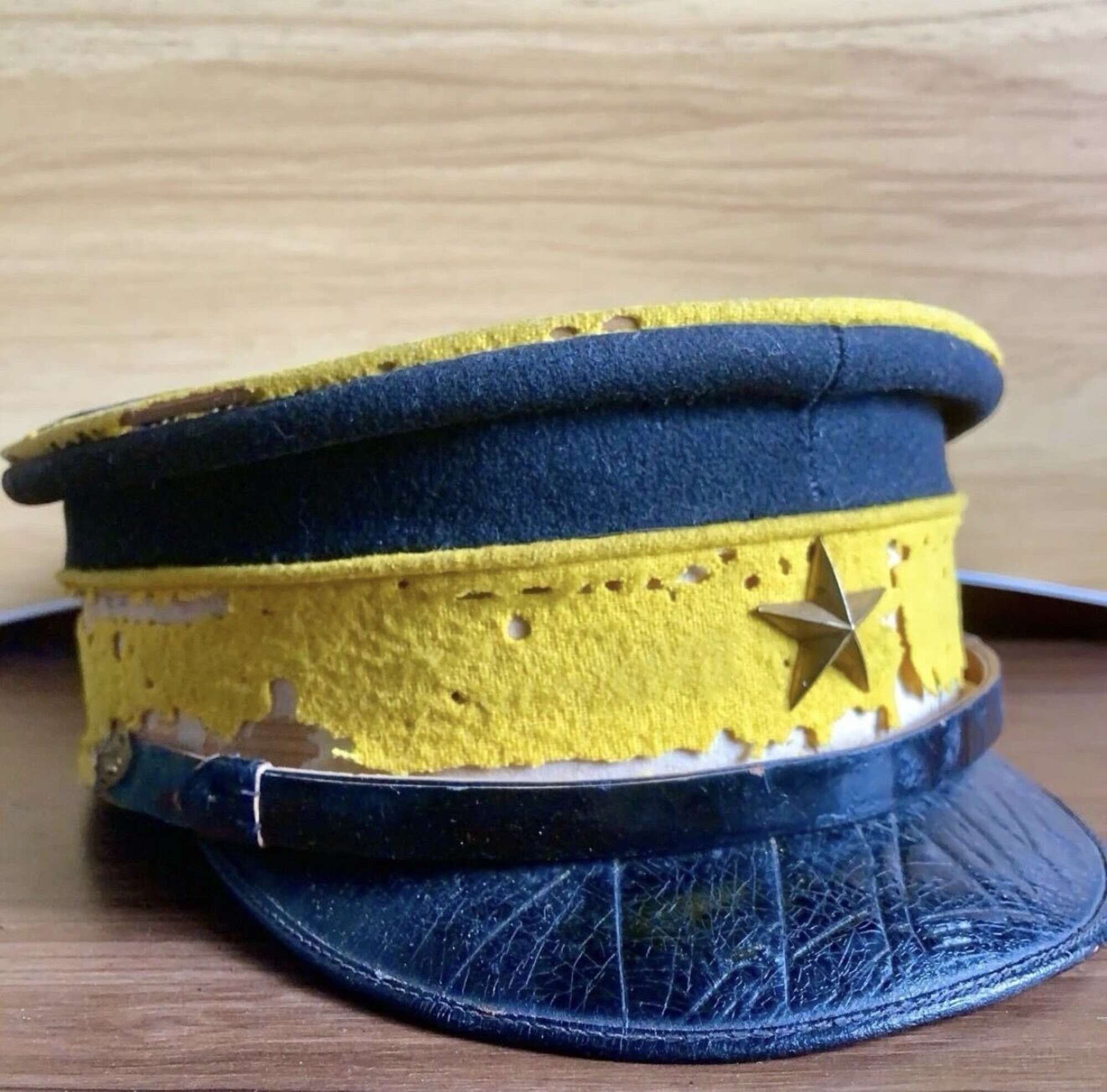


Scarce Russo-Japanese War Imperial Japanese Army Type 19 (Model 1886) Private-NCO Cap 1904
Delivery Quote Request
Please fill in the form below to request a delivery quote from Sophie★Marie de l'Australasie.
Contact Sophie★Marie de l'Australasie
 NSW, Australia
Simply fill in the below form to get in touch with Sophie★Marie de l'Australasie regarding this item.
About this item
Scarce Russo-Japanese War Imperial Japanese Army Type 19 (Model 1886) Private-NCO Cap 1904
The Meiji 19th year (1886) standard, established on July 6, 1886, marked a major shift from the French style to the German style. The second-class caps and uniforms were dark blue velvet for officers and navy blue velvet for junior officers and below.
The second-class cap for field officers had two dark blue stripes. This photo was taken after October 1891 (Meiji 31) (Meiji 33 standard or earlier standard), but there is not much difference from the Meiji 19 standard.
The second-class cap had a small protrusion on the top. The star emblem (cap badge) was gold and measured 1.5 cm from the center to the tip. The visor was made of black leather, with a 0.5 cm wide apex line attached to the protrusion. The lower part (headband part) was just over 5.2 cm high, and the horizontal insignia were different colors for general officers, lieutenants, and other ranks.
The lower part of the headband for general officers was scarlet velvet with three 1-bu (0.3 cm) wide dark blue lines. Field officers and officers of each branch of the military had yellow velvet with two dark blue lines, and lieutenants and officers of each branch of the military had yellow velvet with one dark blue line . Senior guards and junior adjutants and below did not have dark blue lines.
Furthermore, the uniforms of officers of each department were identical in shape to those of their corresponding generals and lieutenants, but instead of scarlet velvet they used the official color of each department.
The uniforms of officers and warrant officers were traditional rib suits, while the uniforms of non-commissioned officers were navy blue velvet short jackets with stand-up collars and buttons , with standard-colored velvet collars and epaulettes bearing the regimental or battalion number (unit number), and rank was indicated by the sleeve lines.
The side insignia on the trousers of general officers and officers of the same rank were given two large lines 1.5 sun wide and one small line 1 bu wide, while lieutenant colonels had one large line 1.3 sun wide. Cavalry lieutenant colonels wore short trousers.
The Russo-Japanese War[a] (8 February 1904 – 5 September 1905) was fought between the Russian Empire and the Empire of Japan over rival imperial ambitions in Manchuria and the Korean Empire. The major land battles of the war were fought on the Liaodong Peninsula and near Mukden in Southern Manchuria, with naval battles taking place in the Yellow Sea and the Sea of Japan.
Russia had pursued an expansionist policy in Siberia and the Far East since the reign of Ivan the Terrible in the 16th century. At the end of the First Sino-Japanese War, the Treaty of Shimonoseki of 1895 had ceded the Liaodong Peninsula and Port Arthur to Japan before the Triple Intervention, in which Russia, Germany, and France forced Japan to relinquish its claim. Japan feared that Russia would impede its plans to establish a sphere of influence in mainland Asia, especially as Russia built the Trans-Siberian Railroad, began making inroads in Korea, and acquired a lease of the Liaodong Peninsula and Port Arthur from China in 1898. Japan signed the Anglo-Japanese Alliance in 1902, and began offering to recognize Russia's dominance in Manchuria in exchange for recognition of Korea as part of Japan's sphere of influence. However, this was rejected by Russia.
After negotiations broke down, Japan opened hostilities in a surprise attack on the Russian Pacific Fleet at Port Arthur on 9 February [O.S. 27 January] 1904. Both sides declared war, and Japanese troops landed in Korea, crossed the Yalu River into Manchuria in May, and landed more forces on the Liaodong Peninsula. In August, the Japanese laid siege to Port Arthur, which eventually fell in January 1905. In March 1905, Japanese troops took Mukden, the Manchurian capital, after heavy fighting. The Russian Baltic Fleet, which had sailed over seven months and 18,000 nautical miles (33,000 km) from the Baltic Sea, arrived in the region in May and was intercepted and destroyed by the Japanese Combined Fleet at the Battle of Tsushima. The war was concluded with the Treaty of Portsmouth (5 September [O.S. 23 August] 1905), mediated by US President Theodore Roosevelt.
The treaty recognized Japanese interests in Korea, and awarded to Japan Russia's lease on the Liaodong Peninsula, control of the Russian-built South Manchuria Railway, and the southern half of the island of Sakhalin (Karafuto). The complete military victory of an Asian and non-Western nation over a European and Western power surprised international observers, and transformed the global balance of power, with the Empire of Japan emerging as a great power and the Russian Empire declining in prestige among the European powers. Russia's incurrence of substantial casualties and losses for a cause which resulted in a humiliating defeat contributed to internal unrest culminating in the 1905 Russian Revolution, during which the Russian autocracy was forced to make concessions. More widely, however, Japan's win effectively damaged the credibility of European dominance in Asia.
Disclaimer: Items related to the Nazi regime or the Third Reich sold by dealers on this platform are intended solely for educational, historical, or TV/film prop purposes. Militaria Zone does not promote, and is strongly against, the hate ideologies and atrocities committed during WWII.
The law regarding sales of items like this vary depending which country you are in. If in doubt, please check the law in your country.
Additional Information
MZ-107144
19th Century, Early 20th Century
Japanese
This item is in stock and available for purchase. Simply click the buttons below to buy now.
Contact dealer Delivery quote Buy on dealer's website NSW, Australia

Over 7 years of sales on eBay for rare international militaria & antiques dated 1500-1945 period from Australia based with worldwide allies warehouse in US/UK/EU/AS/AU


